Lead Nitrate And Potassium Iodide are inorganic salts with distinct properties and practical roles. Their names often appear together in chemistry lessons because they can illustrate how dissolved ions form a visible yellow solid. That familiar color can make an abstract reaction easier to understand. Still, a clear classroom example does not tell the whole story.
Lead nitrate is used mainly as a specialized reagent and in certain industrial processes, including applications involving pigments and materials. Its use requires careful controls because lead compounds are toxic and can harm people and the environment. Potassium iodide has a different profile. It serves as a source of iodide in laboratory analysis and some manufacturing, and it has specific medical uses under professional guidance. In a radiation emergency, public health authorities may recommend it for limited protection of the thyroid; it does not protect against radiation generally.
This article introduces the main uses of both compounds, their differences, and the safety context that shapes responsible handling. It also explains why a shared reaction does not mean the substances have interchangeable purposes. Details matter. A small vial, a printed hazard label, and a designated waste container are ordinary parts of safe laboratory practice, not decoration. The topic can look simple on paper, but real-world handling is less tidy. Any overview has limits, and local safety rules and expert advice should guide actual work.
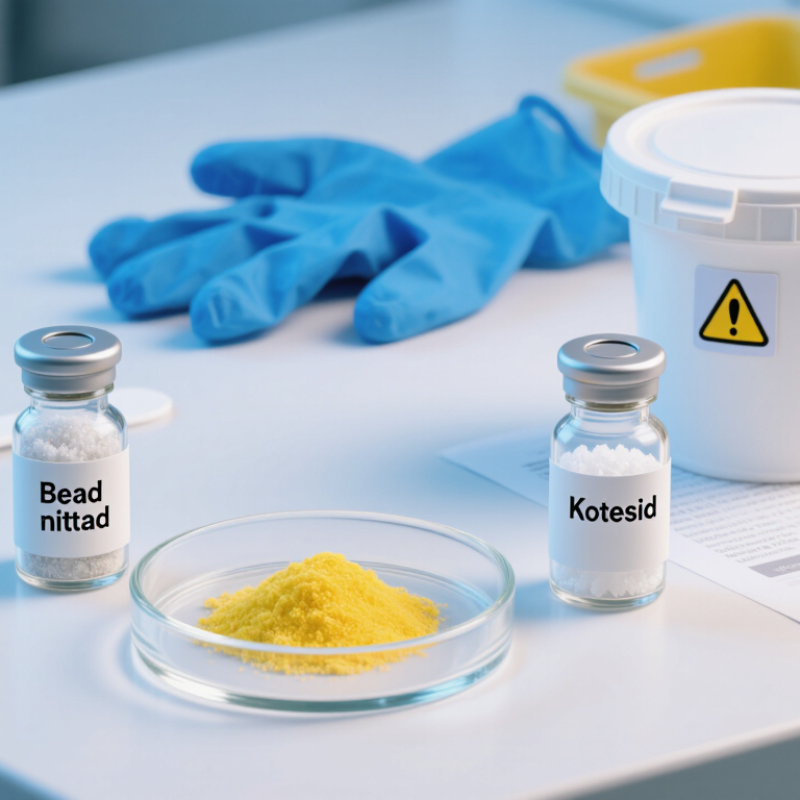
Lead nitrate, Pb(NO₃)₂, is a dense, water-soluble ionic solid with a molar mass of 331.2 g/mol. PubChem’s compound record reports a density near 4.53 g/cm³; its nitrate ions also give the compound oxidizing properties. Potassium iodide, KI, has a lower molar mass of 166.00 g/mol. PubChem lists its density near 3.13 g/cm³, while the NIST Chemistry WebBook gives a melting point around 681°C. Both salts can dissolve in water, but their different ions shape their behavior in solution.
When dissolved solutions of these compounds meet, lead and iodide ions can form bright yellow lead(II) iodide, PbI₂. This visible precipitate illustrates a useful chemical distinction: the starting salts are soluble, while the product is poorly soluble in water. Exact observations can depend on concentration and temperature. That detail is easy to overlook. PubChem and NIST provide reference data, but figures may vary slightly across measurements and reporting conditions.
Tips: Keep samples labeled and dry, and consult current safety data before handling. Lead compounds are toxic, so avoid dust and direct contact; use suitable protective equipment and approved waste procedures. A clear yellow color is informative, but it is not a substitute for controlled measurement.
| Dimension | Lead Nitrate | Potassium Iodide |
|---|---|---|
| Chemical formula | Pb(NO3)2 | KI |
| Molar mass | 331.2 g/mol | 166.00 g/mol |
| CAS Registry Number | 10099-74-8 | 7681-11-0 |
| Typical appearance | White or colorless crystalline solid | White crystalline solid |
| Density | Approximately 4.53 g/cm³ | Approximately 3.13 g/cm³ |
| Melting or decomposition behavior | Decomposes on strong heating, around 470 °C, releasing nitrogen oxides and oxygen-containing products. | Melting point is approximately 681 °C. |
| Water solubility | Soluble; solubility increases substantially as temperature rises. | Highly soluble; solubility increases with temperature. |
| Notable chemical behavior | Dissolves to provide Pb2+ ions; reacts with iodide ions to form yellow lead(II) iodide precipitate. | Dissolves to provide K+ and I− ions; iodide can be oxidized to iodine by suitable oxidizing agents. |
| Representative reaction | Pb(NO3)2 + 2 KI → PbI2↓ + 2 KNO3. The yellow PbI2 precipitate is a common demonstration of precipitation chemistry. | |
| Common laboratory uses | Source of Pb2+ ions in analytical and teaching demonstrations; used to prepare other lead compounds in controlled laboratory or industrial processes. | Source of iodide ions in analytical chemistry, precipitation reactions, and preparation of iodine-containing compounds. |
| Other established uses | Used in some specialized pyrotechnic and industrial applications; its use is restricted by the hazards of lead compounds. | Used in pharmaceutical preparations for specific medical indications, including thyroid blocking in radiological emergencies when directed by public health authorities; also used in photography and as an iodine source in some applications. |
| Key safety considerations | Toxic lead compound and oxidizer. Avoid inhalation, ingestion, and environmental release; use appropriate protective equipment and hazardous-waste procedures. | Avoid unnecessary ingestion or exposure. Excessive or prolonged intake can affect thyroid function; medical use should follow professional or public health guidance. |
Values are representative reference data; physical-property values may vary slightly with measurement conditions and source.
Lead nitrate is a dense, water-soluble salt with a molar mass of 331.2 g/mol. Potassium iodide has a lower molar mass, 166.00 g/mol, and melts near 681°C.
Lead and iodide ions can form a bright yellow solid called lead(II) iodide. The starting salts dissolve in water, but this product dissolves poorly.
No. Color can be a useful clue, but concentration and temperature affect what is seen. It is easy to trust a vivid result too much.
It can help demonstrate precipitation reactions or identify iodide ions. The yellow solid and leftover liquid still contain lead, so the demonstration needs careful planning.
Lead compounds are toxic. Keep containers labeled and closed, avoid dust and splashes, use suitable protection, and follow approved waste procedures.
No. Collect them according to approved hazardous-waste procedures. A clean-looking sink does not mean the lead is gone.
It may help protect the thyroid from radioactive iodine when public health authorities recommend it. It does not protect against other radiation, and more is not better.
Results can depend on sample preparation, reagent quality, and timing. Validated methods and controls help check whether a convincing result is actually reliable.
Lead Nitrate And Potassium Iodide are inorganic compounds with distinct chemical properties and applications. Lead nitrate is a water-soluble lead salt and a strong oxidizing agent, so its industrial and laboratory use requires careful control. It may serve as a specialized reagent or precursor in controlled manufacturing and chemical analysis. Potassium iodide is an ionic salt that dissolves readily in water and provides a source of iodide ions, making it useful in laboratory testing, analytical procedures, and educational demonstrations.
Their applications differ in both purpose and risk. Potassium iodide also has medical uses in specific circumstances, including thyroid protection when recommended by health authorities or a medical professional. Both substances must be handled with appropriate protective equipment, clear labeling, and suitable storage. Lead nitrate poses serious toxicity and environmental concerns, while excessive or inappropriate use of potassium iodide can also be harmful. Safe handling, responsible disposal, and awareness of each compound’s properties are essential.

 VOJIN